It’s a thing often found in advice columns by writing blogs and coaches. If you want to sell more books. Write more books…
This is 100% accurate, but what is often left out is this: What the ever loving hell does that mean?
It’s a vague and obvious statement that most authors are perplexed by, because of course you plan to write more books. But how is that a marketing plan?
I’m so glad you asked! *cracks knuckles*
In this series of articles called Thanks Tips, I will take a vague and cliche piece of writing advice and break it down into understandable steps. Or at the very least shed some light on what it actually means in practice.
Getting readers to see your book is easier than it’s ever been before. Ads are available through Facebook, Instagram, Pinterest, Google, Amazon, BookBub, iBooks, EVERYWHERE!
There are newsletter swaps and blog tours and release blitzes…
The ways to get your book noticed are plentiful so why is the advice ‘write more books’ a big part of your marketing efforts? Can’t I just keep throwing money at this? Isn’t writing books just the creative part not the marketing part?
The actual writing, sure, but once you publish a book it’s a product. A product you use to market your NEXT book.
TWO PHASES OF BOOK MARKETING
Most people stop after phase one, sometimes because they aren’t even aware of how important phase two really is.
Phase one of book marketing is getting readers…again, obvious. Readers need to know you exist, then you need to have a great cover, convincing description page, and a great book.
Phase two of book marketing is keeping those readers. When those readers are done your first book you need to keep their interest. Facebook groups and newsletters keep people around between releases but alone, they aren’t enough. You need to hand them another great book on a consistent and sustainable schedule.
These two phases are necessary to finding, hooking, and keeping your readers coming back for more.
Without phase two, all the money and time you’re sinking into ads and newsletter swaps will lead your readers to a dead end (which is also just bad business).
And what do readers do when they’re done a book?
They read another one.
So if you don’t ‘write more books’ those readers will go find someone else who does.
I’ve read a few posts on this already, but I’m going to throw my few cents into the conversation.
Okay. No cents. Just words.
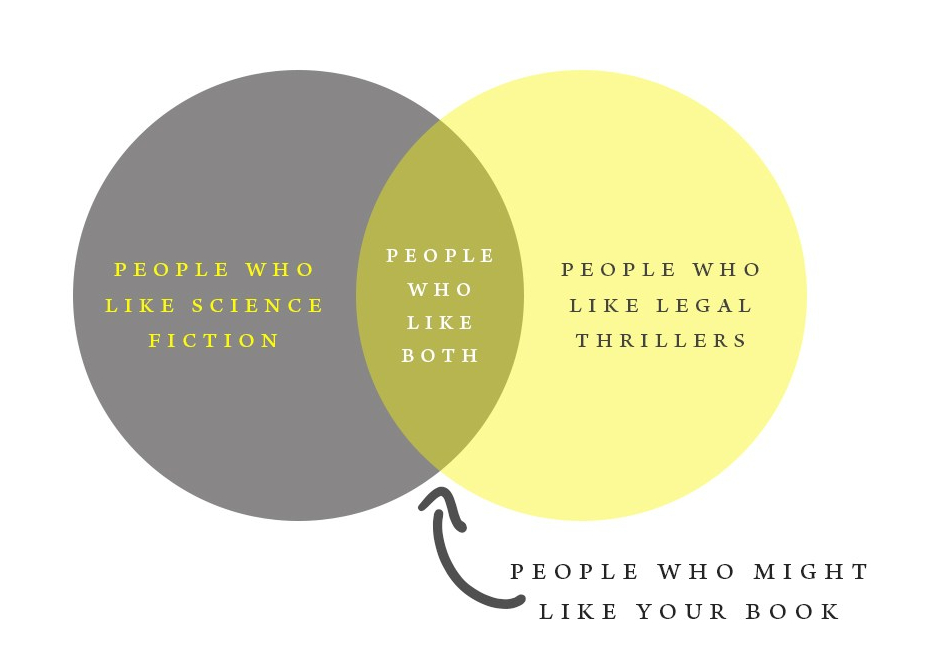
We have this idea that if we write a book that crosses genres rather dramatically, we will widen our audience to epic proportions.
So, if we write a book set on a space ship in the far reaches of another galaxy, but it’s not about the space travel, it’s about a murder and the intricacies of the legal case, we may think – I’M BRILLIANT!!! ALL THE PEOPLE WHO LOVE SCIENCE FICTION AND ALL THE PEOPLE WHO LOVE LEGAL BOOKS WILL READ MY BOOK!!!
MWAHAHAHAHAHAHAHA!!!! *rubs hands together in the knowledge we’ve hit upon a brilliant plan*
But in 95% of cases, here’s what actually happens:
Now. Will there be outliers? For sure. Will there be people who love both those genres but hate your book? Yup.
I feel like this is the case half the time with collaborations. I used to think that it would gain me more readers, and gain my writing partner more readers, but after writing a lot of collaborations, I’m not so sure. I think that happens SOME of the time, but I think MORE of the time, the audience shrinks to mostly the people who like BOTH of the authors.
So. If you’re wondering why your epic swash-buckling fantasy with the occasional robot isn’t selling. This might be the reason. That’s a big risk for publishers. Yanno, we’re back to that idea of Different, but not too different… Think of this like hit songs–you know the ones you think that maybe you’ve heard before? But then realize you haven’t? Do that. 😉
And yes, please bring up Firefly. That show is genius. It was cowboys and space, and because the writing was freaking brilliant, and the casting was perfect, it worked. But please know that’s the exception. Not the rule.
Happy writing everyone!!
Jo
P.S. Allie adds that Firefly was also cancelled, so just because it’s good, doesn’t mean it will be popular…
I’ve re-done entire endings. Sometimes more than once. Sometimes more than 5 times…
I’ve re-organized and spend all day deleting and adding and then deleting and then adding… All on my way to some kind of finished product that’s worth seeing the light of day.
But every word written, every scene, every chapter, every character, every terrible novel that I deleted, re-worked, cut, or left to rot, got me something. Several somethings.
Helped me be a better editor
Gave me a more critical eye when it comes to my own work
Helped me be unafraid to do a REAL revision instead of a patch revision (don’t shift your eyes, I think we’ve all done the “patch” revision instead of the real one – even though we all know they never work)
Made me know that sometimes words, chapters, characters, threads, plots, should be left alone, and again, helped me be unafraid of starting over, of leaving things behind.
The thing is – as long as we’re writing, we’re moving forward. People don’t start running and then head to a marathon. Every word we write is training. Some of those words stay. Some go. Some ideas stay. Some go. But they ALLLLL help you further your writing goals. They all get you a step closer to a finished product.
So. Next time you’re faced with the awful realization that your fav character doesn’t need to be there, or that one funny scene doesn’t quite fit, or that your book just isn’t… Just isn’t going to sell without a complete re-imagination, I hope you remember that there are no wasted words, just lots of steps that get you to your finished novel. And then chant to yourself as you hit delete, “There are no wasted words.”
The act of sitting in your chair and writing new words on a page is not an item that belongs on your To Do list.
Writing is something that needs to be built into your day—like brushing your teeth.
The moment that you put writing on your To Do list it loses its appeal. It’s now one more thing to knock off your ever-growing, soul-crushing list of things to do. You are responsible for the completion of words in whatever limited box you put them in—because I guarantee you put them in a box.
1000 words a day, ten pages a day, one chapter a day…
By placing these output expectations on your writing, you just further ground it into an unenjoyable activity that creates a large open space to fail in.
Setting a results objective for your creativity is a sure fire way to murder the joy of the process. And enjoying the process is the only way you’ll make it through the tough deadlines and bad reviews.
If you can stop setting yourself up for failure and making your words a chore, writing can grow into an effortless habit that becomes woven into your very existence.
But how?
THE DIFFERENCE BETWEEN HABITS AND PRODUCTIVITY
When something becomes a habit, what that really means is that a task you do becomes ingrained in your brain and then begins to happen automatically without trying to make it happen.
Every time you sit down in this chair, or wear those pants, or brew your coffee, you then write new words. Your brain becomes ‘triggered’ by certain actions to settle into creation mode. There is no result or outcome you’re working toward, you are simply writing.
Productivity is forced action attached to a predictable outcome. Productivity is ‘This book is due to my editor in five days, looks like I’m pulling a couple all nighters to get it done’.
Or if you already have a good consistent creative practice then you are able to put more emphasis on output or productivity goals because your foundation is already solid.
You can’t build a writing career in start and stop writing fits of inspiration. Foundations are built in healthy habits.
WHY HABITUAL WRITING HELPS YOU BE MORE PRODUCTIVE
If you’ve trained your brain to do something, and it becomes automatic, wouldn’t it logically follow that you’d have more mental space to shape it into something bigger, better, more efficient? Good habits set the foundation for increased productivity.
When you can get to the point that writing just happens when you sit in your chair, wouldn’t it make sense that you would feel more relaxed and comfortable ‘getting into the zone’ and therefore be able to crush specific deadlines?
Habitual writing also gives you reliable data that is organic to you. If you force yourself to write X words per day because some online expert said you should, your output is not organic, so you have zero idea if it’s sustainable. When writing becomes a habit, you have accurate and reliable data on how many days a week you can comfortably write, how much time you can afford to dedicate to new words, and how many words you can average in a specific time frame.
Two things are extremely important when building a writing habit.
Separate creative writing from business writing. This means that when you are habitually writing you are more focused on stretching and strengthening your creativity.
Habit writing is NEW words.
Not editing old words, not rewriting old words, not rearranging words. Brand new words in your WIP or a short story or flash fiction or a new idea. Writing NEW words on a consistent basis (even if it’s only a few moments) is what will build your confidence in your ability to sit and create on command.
Business writing is getting that book polished for your editor, hammering out the next draft of your WIP, or any writing that has an outcome/deadline attached to it.
The second thing is forgetting about the end and focusing on the beginning. The habit is NOT in how many words you end with. It’s not even in the amount of time you dedicate. The habit is in the action of sitting down to write. Of beginning. The only way you train your brain to create is by showing up consistently.
1. SHOW UP
Show up, and keep showing up. No matter what. Pay attention and adjust accordingly. Set a timer for 10 minutes. If that doesn’t work try attaching your writing to something else, like you have to write before you are allowed to check your email in the morning. Go early to pick up your kid from school and write in the car while you wait.
2. EXPERIMENT
There is NO formula. I repeat, not one single formula that works for every writer. Sure look up other writer’s processes and try them out but always be willing to play, tweak, shift, or adjust anything that doesn’t feel right to you. Writing is hard, but if you’re miserable and unfulfilled, try something different.
3. MANAGE EXPECTATIONS
Inspiration is bullshit. Consistency and healthy expectations are what create solid writing foundations. If you expect that you will be overtaken by the Muse of Storytelling and feel her magical influence bursting through your fingers as you wildly type the best story ever written…you will fail.
Yes, those moments happen, but they are not how careers are built. They are simply moments. Careers are built by putting one word after another over and over and over again until you finish. And then repeat.
Expect to love it sometimes, to hate it sometimes, but also expect that the more consistently you show up and write new words, the stronger your writing will be.
I’m a huge believer in having as many self-editing tools as possible, and this is one of my favorites.
Each scene in our manuscript needs to count. Each scene needs to move the story forward, give the reader new information, and help your reader to experience the story.
Every time I give you writing advice, or process advice, I urge you to test it out, but also, to make it your own. I start most writing or editing sessions with a drink and a snack–I’m a kindergartner at heart.
So. Now that I have my munchies, I lie on my stomach, pull out a pen I like to use (today that pen happens to be purple) and start at the beginning of my novel. Laptop resting off to the left, notepad to the right (me being right-handed and all).
For each scene, I write down – WHAT DO I LEARN? And then, in very simple terms, what I learned.
Next I write – HOW DOES THIS PROPEL MY STORY FORWARD? And then another very simple sentence, or bullet points, on how this pushes the plot forward.
OK. Actually. I don’t like writing longhand so I just write LEARN: and then PROPEL: And it looks like this:
There are times when I realize that good information is given, but the propellant is weak.
There are other times when I realize that nothing new is revealed, so that propellant needs to be used somewhere else.
Sometimes I realize that I’ve learned the same thing twice. A reminder is okay, but not a re-learn.
By default, the propellant and the info should be related–meaning, they either need to work together, or work against each other.
Sometimes I make notes in my notebook as to how things need to change. More often in comments throughout my MS. I don’t change yet, I just plan the change…
Then, I think: How do I want my reader to feel? And have I created that experience, or am I telling them what to experience? (Hint: Always create the experience).
And then after a workout, or cleaning part of my house, or taking a day or a week to sort the story and its needs out in my mind, I start at the beginning and tweak the parts that need tweaking.
This is the simplest way to make sure that each scene is earning its place in your manuscript.
Happy Editing!
~ Jo
If you want to share a favorite revising tool, PLEASE DO! We can always use more ideas to try.
When you know something—like truly understand it—you just do it. With little effort or thought, it just happens.
This is why some people suck at teaching others how to do what they specialize in. Because in order to teach you have to start at the beginning.
Not the beginning for you. The beginning for someone who doesn’t know squat about what you are awesome at.
It’s the above reason that I think so many authors get all twisted around when looking for how to publish their fiction online. There are millions—and I do mean millions—of resources in Internetlandia about writing, publishing, and marketing your books.
But too many of them start at step five.
Even the oh-so-simple advice of Write a good book and market it to your ideal reader is stress inducing because WTF is a good book, how do I write one, who is this ideal reader person, and what in the frickin hell is the best way to market to them?
Here at Waypoint, our goal is to help you understand writing, publishing, and marketing by starting you at STEP ONE. We believe that a good solid foundation is the only way to grow a sucessful career in fiction writing. But we also believe that it doesn’t have to be so dang complicated either!
So if you’re ready to rip up all that bad advice and relay a proper foundation to your career, read on…
What’s your point?
Before a marketing plan, before the ideal reader search, before keywords and categories, heck, even before you write the first word of your first story I want you to answer this question: What’s my point?
The answer to this question will clear the path to your writing career from story to market.
Fiction is about observation. Fiction says something about life. Even the fluffiest of fluff romance still makes a statement about what it means to be a human in this world searching for love and acceptance.
And I promise you that if you spend some good quality time pondering this question every single thing you do afterward will be easier. Miniscually, maybe, but you will have a clear understanding of what you’re saying and why you feel compelled to share this with the world.
Once you know the point you are making—or the observations about humanity you have—your stories will breath deeper, your readers will understand you more clearly, and your marketing plan will have natural direction.
By picking up that pen—or opening that word processer—you are claiming you have something important to share with the world no matter what genre you write.
I’ve been in a few conversations lately that remind me how much writers treat their works like their children.
I have a good friend who I’m sure will hit the publishing world in a big way at some point. There’s a fantasy he’s been working on for a long time. It’s the first writing project he threw himself into. He said this in our chat the other day –
“This fantasy is my baby but I’ve felt for a while I might need to try a few other ideas. I’ve felt a little stuck on this one but was afraid to set it aside.”
After a decade of attending writing conferences, I can say that I see this ALL THE TIME. And I’d like to add, right now, don’t be afraid to set projects aside. This helps give you time to grow as a writer, time away from the project so you can see it with new eyes, time to try other worlds, characters, and problems. That’s a GOOD thing.
But that idea we start with, or that idea we’re so excited about, can feel slippery and precious. We have this thing and we want it to go running out into the world before…it breaks? shatters? someone else does it better? a million other terrifying scenarios that print themselves on our thoughts when we’re trying to sleep?
In a conversation with Rachel Larsen (Host of the podcast HUMANS DEALING WITH HUMANS, which you should totally listen to) she said the following –
“Once you have a book, and you’ve worked so hard on it, there’s this sense of urgency, like – I have to get this out now. Otherwise, the idea’s gonna go stale, or whatever it is…The fact that you have words down on paper or you have this story or whatever, it automatically adds a ticking clock into the mix, when really, there isn’t one.”
At every writing conference I’ve ever been to, I hear some version of the following: You just have to keep pushing, and you’ll get there. Don’t give up and you’ll get there. Keep working, and you’ll be published.
And while those things are true, what they forget to say is that sometimes it’s GOOD to step away – maybe step away from writing altogether – it’ll still be there when you’re ready to go back to it. Maybe, it’s just that you need to set a project aside in favor of something shiny and new. Your process is just that, IT IS YOUR PROCESS.
If your process means that you work on fifteen different books in two years before you find one you love enough to see through to the end, so be it. If your process is working on the same project for ten years, own it. (Although, I generally think this is a terrible idea, which I may or may talk about in the future). And you may be like me, and need to have a few projects, in varying stages of completion, some of which will leave your computer, and some of which will not. That’s also okay. You may realize that your writing is causing more stress than you imagined, and LIFE IS SHORT people. Take a break. Taking a break isn’t failing, it’s being smart about how you’re spending your time.
So, there you are. For whatever it’s worth (this post is free), Jo says you can step away and feel good about it. You can start that new project and feel good about it. You can re-evaluate your publishing goals AT ANY POINT because they’re your goals. Your interests will shift. The amount of time you have for creative endeavors will shift. Things you thought you wanted out of your stories may change. Changefulness is SUCH an attribute. Use it. Own it. Do what works for you.
Also, take a deep breath, and enjoy the fact that you have the luxury of writing stories.
Waypoint Author Academy is your first step on the journey to becoming a confident writer and savvy business person.
Because whether you’re blazing your own trail in self publishing, or are pursuing the well trodden traditional route, at the end of the day you are still in a business.
Here at Waypoint our goal is blend writing, publishing, and healthy mindset to help you become a powerhouse publishing professional and the author of binge-worthy books your ideal readers can’t get enough of.
Waypoint is the place to be if:
you are brand new to writing/publishing and want to be sure to start out on the right foot
you have been in the industry for awhile and are overwhelmed by all the options and apps and channels for authors to publish and market
you need a quick refresher or reality check to get you out of your head and back into the flow
you want quality information from industry professionals who you can trust to guide you with honesty, integrity, and compassion
Waypoint is absolutely not the place to be if:
you are looking for a magic bullet or quick-fix to game the system and boost your vanity metrics only
you want all the readers and think your books are for everyone
you are not ready to implement long-game strategies, and attract only the ideal readers to your books
Campus Tour
Waypoint Author Academy is a virtual learning hub designed specifically to help fiction authors build long lasting and profitable careers.
In the online space non-fiction and fiction authors are often lumped together in articles about publishing and marketing but the frustrating truth is that they are not even close to the same.
Waypoint focuses on marketable genre fiction and authors who want to produce quality books for a voracious audience.
Take a look around and see if Waypoint is a good fit for you!




















 Waypoint Authors