+

Edit Levels: What They Are and Why They Matter

Photo by Suzy Hazelwood on Pexels.com

Over and over I see people agonizing over word choices and commas before their story is figured out. Or beta readers marking copy edit style edits when the author doesn’t yet know if their story works–or if the scene the reader is editing will even make the final cut of the novel.

This is why it’s important for an author to know what to ask of their editors, beta-readers, and what to expect at a traditional publishing house. You will lose both time and money if you’re asking someone (or yourself) to copy edit a chapter before you’ve figured out your story. You’ll have a hard time finding a good editor match if you’re not communicating what you need. And finally, it’s important to know what a publishing house should do for you if that’s the route you choose.

LEVELS:

Developmental/Story/Big Picture Edits

Line Edits

Copy Edits

Proofread

A Developmental Edit asks the following:

Does the story work?

We focus on:

Protagonist – is this your POV? Is it not? Do we understand the protagonist’s motivation as the story progresses? Do we see growth?

Point of View: Have you chosen correctly for your story?

Plot/Pinch Points and Pacing: Does the story make sense and have good flow?

Tension/Stakes: Are the stakes clear?

Characterization, Setting, Overall Story Arc, and Tone – were the promises made in the beginning, kept in the end?

Until you know that you have a solid handle on the above, there is no point in moving on to line edits.

A Line Edit asks the following:

Does the language support the story?

We focus on:

Seeking and destroying weak language

Showing and telling (which is allowing the reader to experience, rather than telling them about the experience)

Helping integrate action, internal thoughts, and setting in a way that meshes with the story arc, character, and plot

And until your language feels strong, there’s no point in moving on to Copy Edits.

Copy Edits ask the question:

Does the grammar support the language?

This is where grammar nerds get giddy 🙂

We focus on:

All the little things that are missed/skipped over in line edits:

Commas, capitalizations, consistency in the way numbers and time are written on the page, as well as making sure the proper version of particular words are used (words your spellcheck won’t flag because they’re spelled correctly, but aren’t the right version of the word = ate, eight).

Timelines are often finalized in this round. This round really does focus on the joy of grammar nerdery and making sure all the little details are uniform.

A Note on Proofreading: If you’re publishing on your own, or submitting to agents, consider putting your novel on paper or on your e-reader to help you find the small details. And keep in mind that publishers used to have a book proofread by 10-12 people before printing the final version.

AND FINALLY: Always note that the best a human can do is 95% accuracy. Be kind to yourself. Be kind to your readers. Be kind to your editors. We will ALL miss something in your manuscript.

As you move forward with your writing, I hope this helps you set some specific goals, as well as helping you save time by not doing line or copy edits while you’re still figuring out how to best tell your story. And if you’re not sure what your story needs – this is why SO many editors out there will offer a free edit sample and advice as to how best move forward with your manuscript. Take advantage of that!

You can learn more about our editing services HERE. And if you’d rather chat it out, you can see the details of that HERE.

Happy Writing! Jo

+

Why Releasing While You Write Kills Your Creativity

Photo by energepic.com on Pexels.com

Are you releasing your book while you’re in the process of writing your first draft? If so, you could be killing your creativity and stunting your book’s progression from idea to full story. 

Self-published authors have a lot to consider, from book concept to publication. That means it’s a little too easy for us to get ahead of wherever we are in the publishing process now. If you’re pouring time and energy into planning your book’s release while trying to create the first draft of your book, you’re going to sabotage your process.

How to Prioritize Publishing Tasks 

Self-publishing can be incredibly overwhelming for many authors because we’re responsible for every part of the book development process. It can be difficult to prioritize each piece of the puzzle well, but it’s important to put each phase in its place early on. 

Let’s simplify it: if you’re in the middle of writing your first draft of a new book, focus on writing. Full stop. Once you reach the editing and polishing processes, it’s much easier to begin thinking about marketing and sales. 

(I’ll pause there to note that there is a significant difference between sharing your progress and promoting your book to secure sales. Posting unedited snippets, talking about your characters, and sharing things with readers about a WIP is different than trying to get new readers, attracting them to your pre-order, setting up ads, and other sales-related tasks.)

The ability to prioritize your process will help you keep your head in your story while you write. Prioritizing well requires a shift in perspective. 

First, acknowledge that selling your book is indeed important–once your story is complete. Then, stop worrying about how, exactly, you’re going to sell all the copies you need to break even on your investment (you know you’ve done it–me, too). 

Cutting out the worry requires having a “Yes, and” discussion with yourself. If your inner monologue is working overtime to convince you that you have to think about sales now, just respond with, “Yes, and I’ll handle that when the book is finished.” That way, you’re not spending a ton of energy arguing with yourself. (But if you are, you know…no judgment here.)

Now that we’ve established that “yes, brain, sales are important,” here’s another critical point: the process of creating a story is a journey, and your finished book is a product

It’s counterproductive to worry about selling a product you haven’t created yet. So, let’s differentiate the story from the product in order to prioritize effectively. 

Storytelling ≠ Selling

The creative process of developing your characters, building your world, and discovering your plot is a journey. You need focus and undivided attention in order for your story to become fully realized. That requires a lot of creative energy, and it’s important to preserve and protect that energy while you’re developing your book.

The editing process takes the story you’ve created on your journey and refines it. Like writing, editing requires a tremendous amount of creative energy–though it’s channeled in a different way. 

Once your book is finished and ready to be released, it becomes a product that you now need to sell. Shifting your perception of your book from a journey to a product helps you to detach from it before you launch.

Selling Requires “Strategy Brain”  

Releasing (mentally) while you write drains creativity and moves us into a completely different headspace–let’s call it “strategy brain”. Strategy brain will not serve your story creation process well, so you need to put it on hold while you write.

Marketing and selling require strategic thinking, positioning, and carefully-planned action in order to get your stories into the right hands. But if you think with your strategy brain while you’re trying to craft an incomplete story, you’ll inevitably end up writing it to satisfy whatever strategic criteria you think you need in the moment. 

For example, let’s say you’re a romance writer, and you want to boost your sales. Rather than diving deeper into your own values as a storyteller, you look to what the market is doing–and you notice that sexy books seem to be selling really well. You don’t really want to write steamy books, but you begin adding sex to your stories to meet market demands. You’re suddenly not feeling so great about writing this story, right?

(While market research can be very valuable, it can also be subversive. So if you’re researching trends, stop to ask whether the trends for your genre align with your values as a writer before you dive in headfirst.) 

Strategizing while you write doesn’t serve you as a writer–and it also doesn’t serve your characters, your story, or (ironically) your readers.

Simplify Your Process

Trying to figure out how you’re going to sell a product you haven’t yet created puts too much pressure on both the story and the creative process. When in doubt, keep your process simple and stay focused on the phase you’re in right now.

Remember, you get the final word on how you’re going to get your stories into the world. Taking things one step at a time is the real secret to successfully publishing and selling your books.


Take the FREE Quiz now and build a custom author platform
+

The Business of Fiction: Platform vs Brand

There are three main ingredients when it comes to building your fiction career: Mindset, Business, and Craft.

All three of these must work together, inform each other, and drive your strategies. If you only focus on one or two (you’d be amazed at how many authors only pay attention to one), you’ll never reach your big goals. Or maybe you will, but chances are you’ll be too exhausted to enjoy your success.

In a series of articles called The Business of Fiction, I will be discussing what it means to be a profitable author in the current climate and the biggest mistakes authors make (myself included!).

The first step is to understand the differences between a platform and brand, as well as how they both serve you. Building a platform and brand is not complicated once you untangle all the terrible advice you’ve probably gotten about how to turn your hobby into something more.

A Platform is the map of your career that you lay out for your readers. Your brand is what they can expect while moving through your map and interacting with you and your books.

Let’s start with your map.

Platform: Plan Your Reader’s Journey

This biggest mistake authors make in platform building is letting other people map out their route. They let their readers dictate where they go in their career. They join social media sites because some self-proclaimed expert told them all the readers are on {insert platform here}, or you won’t be successful unless you act like {insert famous author here}.

The only thing you need to do is what you’ll actually show up to do.

I’m going to start by busting through your objections right out of the gate because I know what you’re thinking…

But I write for my readers, why wouldn’t I be where they are?

And certain social media sites have proven and measurable success rates, why wouldn’t I want to be there?

This is the first instance where we can see how Mindset, Business, and Craft all intersect. If you are fully blending these three aspects of your career, you can absolutely cater to readers wishes and you can jump onto social media sites for fun, knowing that the article you just read will yield you some results.

But what happens when you aren’t in alignment? You maybe let readers bulldoze you with demands to write a certain way/thing and you’ve grown to resent your writing and your readers. Insecurity could be gripping you, making you change your stories for your readers because you don’t want to be criticized or rejected, but now your stories just feel like watery soup. You could be writing to market because you’re desperate to make money and wondering why you can’t force yourself to sit and write, or plan that launch.

You are so desperate to succeed that you’ve completely erased yourself from your own career…scrambling to keep up to everyone else’s expectations.

So how do you set yourself up for amazing readers you’ll love to please, and a platform map that makes you excited to engage?

It might feel counterintuitive but it shouldn’t.

Here it is:

Put yourself back in the center of your writing.

It’s your life (mindset). Your career (Business). Your voice (Craft).

The counterintuitive part is this: the more you build your career around the authentic you the more your readers will feel like it’s about them. The key is real connection.

When people think you aren’t in charge, they will try to take charge. That’s why readers begin to direct and dictate even though they aren’t really aware that’s what they’re doing. They probably truly believe they are helping. But a hundred peoples’ good intentions will get overwhelming fast. You must be in charge of your platform.

Narrow in on yourself, and expand your reach.

When you’re building your platform and crafting your readers’ journey, create your map (where you’re aiming to go) with your values at the heart of it all. The readers who connect to the real you will happily walk your route. Those who won’t, will know to move on to a different map.

Once you get readers interested in your route, and their feet on your trails, you have to be sure you live up to the promise you just made them.

And that is your brand.

Brand: Your author promise

A brand is the meeting of set expectations.

You promise your reader a certain outcome (inspiration, entertainment, education, escapism, immerse, etc), a route to get there (connection, fun, activism, feminism, authenticity, fantasy, reality, etc), and an underlying tone (serious, funny, dark, sarcastic, vibrant, peaceful, relatable, luxurious, etc).

This is an area where insecure or inexperienced authors allow their readers to set the expectations for them, but here’s the problem: How can you meet the individual expectations of hundreds of people?

You can’t.

If you come out of the gate setting the expectations for your readers and then consistently live up to that promise, you will build a readership full of happy, engaged, loyal fans.

The moment you act off brand, you fail to meet the expectations of your readers, and they will begin to mistrust you.

What does that look like? A clean romance author using a cuss word in a social post. A weekly newsletter that ghosts for two months. A dark fantasy author making a sappy gushy post. A hard hitting activist buckling to corporate pressure. Really any number of things that just don’t line up with what you’ve told your readers you’ll provide them.

This is why it’s so very important to map your route (platform), set expectations (brand) from the get-go, and infuse it into everything you say, do, and create online. If you aren’t creating your career with you at the center of it, it’s inevitable that you will lose control of your work to your readers/agents/editors which will lead to overwhelm, burnout, resentment, and a whole pile of resistance to writing.

Show up as yourself with the intention of serving your readers and you can’t fail.

Help your audience by being yourself

When you show up as you, you are serving your readers better than you ever could by trying to fit in to industry norms or follow guru advice.

When you love yourself, you give permission to others to love themselves.

When you write your true voice, you make other people feel heard.

When you are aligned with your values, you make others reflect on their own.

Being you when building your author career is not selfish, it’s not arrogant, it’s not boring, or boastful. There are people out there who need to hear the words you have to say, and you’re not helping them by ignoring, avoiding, or scoffing at your online presence.

Your platform is built around you, but for them.

Click for your free platform strategy map.
+

Productivity Tips in Uncertain Times

 We wanted to show our readers what a typical Waypoint Newsletter looks like. This was our most recent, which we wanted to stretch far and wide:
Thinking about your story is important. Working things out in your head like plot, setting, pacing, characterization IS writing. So don’t beat yourself up or feel stressed out if you can’t get the time to sit and write. Keep a notebook or note app to jot down anything important and when you have time to write it will come out that much faster.
Taking care of yourself. It’s hard to create from a place of fear, stress, or desperation. Be sure to take time to center your thoughts, care for your mind, reach out for help, and tend your body. Creativity runs dry and the only way to fill it back up is by being present in your life. What makes you feel real joy, hope, or love? Do more of that. Now more than ever. 
No one knows how this will play out. But that’s always true. You never really know what’s around the corner. There’s one thing you can know for sure. Yourself. Use this time (if you have it, even a few moments) to work on things that don’t take up too much creative energy. Learn about amazon ads. Take that free course on marketing. Tinker with your website. Finally set up that email list you were planning. Use your time to build your platform so when things settle and bills need to be paid you’re ready and you’ve set yourself up to bounce back faster and stronger. 
Reach out to your author community. Network with other authors and see where you can add positivity to this amazing community. Use your skills to help others and keep your moral strong. It will help. Because it’s easy to think that what we do in times like this isn’t important and keeping a finger on the pulse of the writing community will help to keep you moving forward. Because like I said at the top of this letter, who are people turning to?
I know that you are strong and resilient but if you need a little help please reach out. I’m here to answer your publishing questions and help keep your author path clear of debris from this emotional and physical storm as best I can. Let me know how you are doing and if there’s anything I can do to help. Even if it’s as small as “That email list thing sounds good right now, where do I start?” 
REPLY TO ME
  • You can keep up to date on new courses and workbooks on our Facebook Page HERE
  • Join our group for community support and ideas HERE
  • Receive our Waypoint Community Newsletter, and grab your free Fiction Pathfinder HERE

Thank you so much for being some of the first to join our Waypoint Author Community!

+

A To-Do List vs A To-Be List

Photo by Kaboompics .com on Pexels.com

Productivity is at the forefront of everyone’s mind this month. How can we crush 2020 and dream big and get more—health, money, happiness, and so on?

What do we need to DO to get where we want to go?

I’m here with a different question for you today.

Who do you need to BE to get where you want to go?

Some people love and thrive under the pressure of a To-Do list. Those people are results people—The puzzlers, the gamers, the reverse engineers of productivity. If you are one of those people, we love you, but this post isn’t for you.

This article is for those who freeze up, shut down, or feel anxious at the idea of a long list of tasks to complete. These people are identity first people.

If they don’t believe they’re the kind of person who CAN do all these tasks, they won’t. No matter how beautiful their planner is…

Note: If you need or want a more in-depth explanation of this concept of Results First or Identity First, you must visit the genius brain that is Jessica Eley and listen to her podcast and watch her workshop.

After going through her workshop, I realized I’m a hard-core be-er. I need to believe I’m the kind of person who gets stuff done before I can jump into action.

That’s when I decided to start a To-Be list instead.

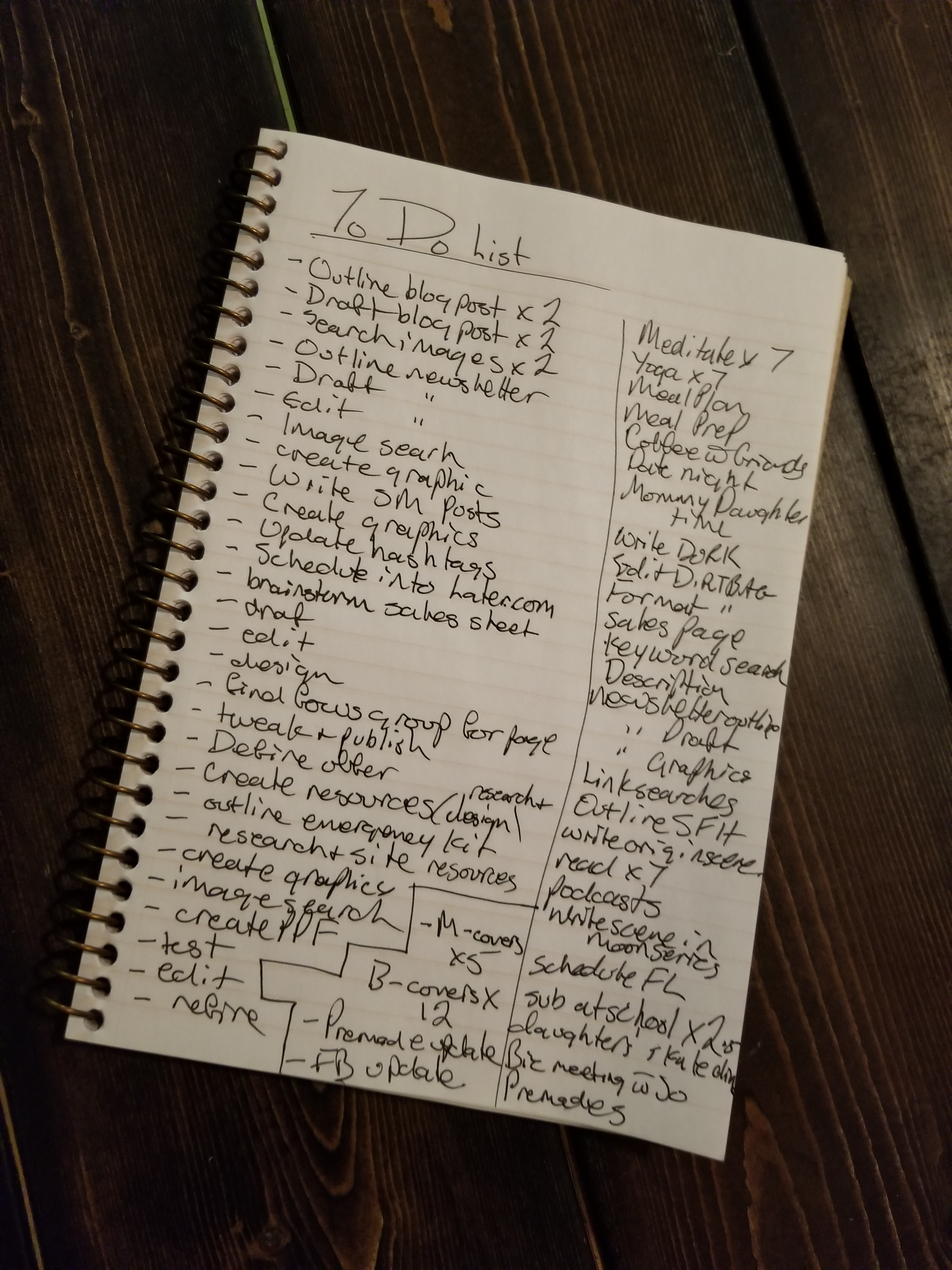
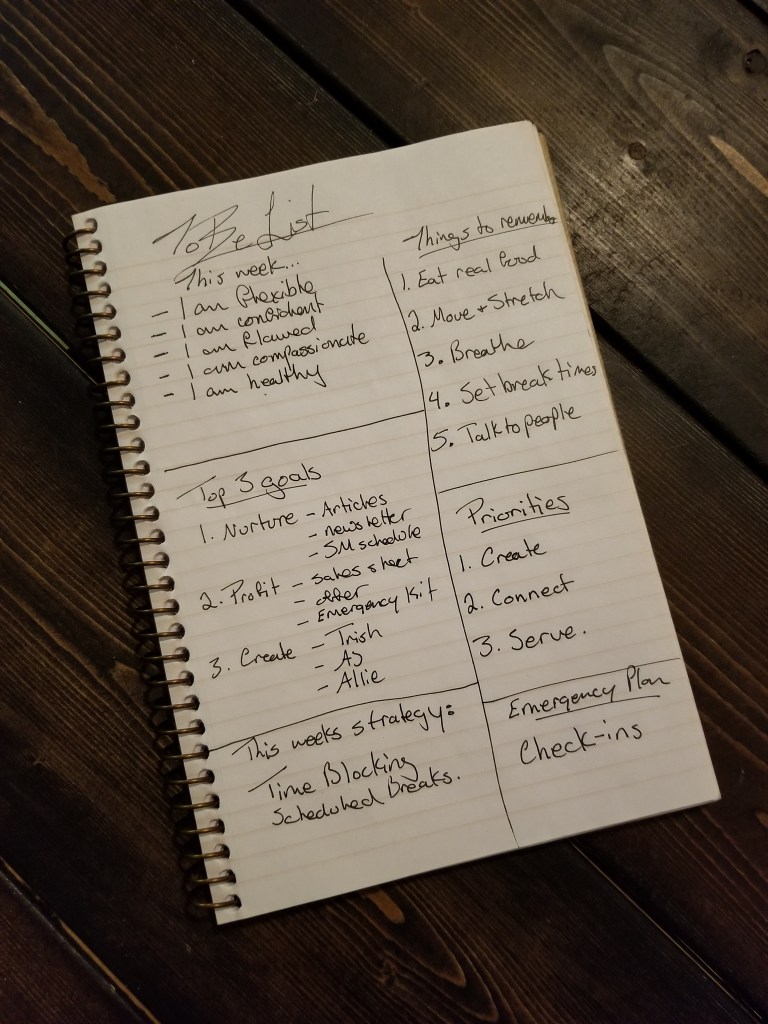
I still have the same goals and aspirations as anyone else, but instead of my list looking like this:

It looks like this:

Instead of looking at what you hope to achieve in 2020— ending in a paralyzing To-Do list—create a list of ways to be. See how it feels.

I could write a dozen articles on how my To Be list is organized, and who knows—maybe I will. But my timer is about to go off and I’m scheduled in for a break…


+

Five Things I Learned from Story Genius

I love STORY GENIUS by Lisa Cron. I recommend it for everyone who is a writer or wants to be a writer.

But I especially recommend Story Genius for those authors who want to be traditionally published, receive requests for full manuscripts from agents and/or publishers, but keep getting pass letters.

This book will help you gain that final layer so necessary for great books. I also give an extra-big recommend for people who are finally sitting down to write that book. You know, that book you HAVE to write? Cron will help you find the heart of your story.

TAKEAWAY ONE:

It’s not a final layer that’s missing when a book is missing that spark, but the internal layer. The beginning layer. The seed and drive of the story. 

When we read, we read to experience. And we can only share that experience by digging so deeply into character, that the character drives the story.

At the end of it all, a good story will always match up with some sort of plot structure—the heroes journey, 7-Point Plot, Save the Cat beat sheet, and with a million others.

But without that core, that heart, a novel could still be lacking. We need to see characters facing the hardest things that they’re going to face. We need to see the lies that they tell themselves. We need to experience the lies and walls that they’ve used to protect themselves being slowly pulled away.

TAKEAWAY TWO:

Our character, and our way of giving that character a voice, is the thing that’s going to set our story apart. There are VERY few, if any, truly original ideas–only new ways of exploring those ideas.

TAKEAWAY THREE:

We need to BE SPECIFIC. Not just say –  what if a boy who lived in the cupboard under the stairs found out he was a wizard, but something much more specific. What if a boy, whose parents he always missed, learned that he was part of a world he hadn’t even imagined, and that his parents were heroes in that world, and that he was expected to be a hero as well.

TAKEAWAY FOUR:

No matter how many points of view we have, there is often only one protagonist. One characters growth arc is dominant to all the others.

TAKEAWAY FIVE:

What internal fear will the character be forced to confront? What long-held desire will give the character no choice but to finally go after it? What are things that the character wants? Keep in mind that most of these things are going to be traced back to an event that happened before your novel begins

Happy Reading!

~ Jo

P.S. Allie here to add my BONUS takeaway from Story Genius (which I also love, because brain science!).

The Origin Scene. Cron encourages you to actually write the scene when your character’s lie takes root and alters their future.

What happened the exact moment the character made up their mind to believe the lie that your plot is about to challenge? This exercise has changed my world. If you want to know how to do the exercise I’d recommend picking up her book at your fave retailer!

+

Thanks, Tips: Know your Genre

Welcome back to a segment called Thanks, Tips, where I break down vague publishing advice and make it more transparent or actionable for you. 

This installment looks at the phrase Know Your Genre and helps you to understand what it means and how to do it.

Photo by Negative Space on Pexels.com

Phase One

The simplest iteration of this is you have to know where your book fits in the market. What BISAC code will you use? What categories does it fit in on digital retailers? What shelf would it sit on in a bookstore?

Phase Two

What do your readers expect when they open your book? It’s essential to understand why readers like your genre, and then you need to play to those conventions in some way. 


Now, I’mma stop you right here before you even say it. You are not recreating the genre. You are not crushing the tropes, and you are definitely not educating the readers of your genre on why what they’ve loved up until this point has been wrong. 

If you try that, you are murdering your career. I promise you. There is nothing readers hate more than being talked down to by an author. 

These moments happen mostly in the romance genres because some pompous newbie author decides they’re going to write a “real romance” with all the corrections and right ways to do it. 

Just don’t do it. Please, for the love of all things sacred in this world, do not try to show readers why they are wrong. They’re not wrong. And you will only come out of it looking like an ass. The only thing that will set your book apart in the genre is if you are faithful and loyal to your voice and your story. Don’t try to rip off a popular series either—that’s the flip side of the argument.

Whew, sorry about that. Tangent complete. Back to the good stuff. 


Know your Genre

Photo by Adrienne Andersen on Pexels.com

Putting it all together

  1. Read in your genre. Anything and everything you can get your hands on even if it’s only loosely tied to what you’re writing about. Sometimes authors like to think that what they are working on is so shiny and new that it couldn’t possibly fit in such a tight genre box. It can, and it should. Readers don’t like to take risks, so if you can’t clearly state why they’ll enjoy your book, they won’t pick it up. 

    ACTION: Go to your library and pull a stack of books that you would love to read. Sit on the floor with them all and scan them. Look for things like voice, POV, chapter length, structure. Just take it all in, and if the book hooks you take it home. You can do the same thing on your favorite e-retailer and download a ton of samples. 
  2. Research your categories and BISAC codes. Hop on the Google and check out BISAC codes, which is how all book retailers classify books, so they know where to put them. Your story can have two on Amazon and up to five on other sites. 

    ACTION: For Amazon categories, get onto the top 100 lists and start down that rabbit-hole with pen and paper handy. If you have KDP Rocket, this research becomes extremely simple, but it can be done on the site. List out your five BISAC codes in order of importance, and choose ten categories on Amazon.
  3.  Compare your book to chart-toppers in your categories. Note here I did not say compare yourself to bestselling authors. Please don’t get stuck here, feeling like you’re not enough, or that you’ll never live up. This exercise is about figuring out your genre and collecting data on books that have similarities to yours in trope/convention/tone. It is not about your worth or value as an author. You are enough exactly as you are.

    ACTION: Find the top ten books in your ten different categories. What books are crushing multiple charts? What do their covers look like, and how are their blurbs written? Are they KU or Wide? How many reviews do they have? What are readers saying about the stories? 

Once you have all this data, you will naturally see how and where your book fits. You’ll know where to say Hell No, or Yes, Definitely as you write, edit, cover, and publish your book. Knowing your genre is about having a broad understanding of what is happening in the industry so that you can make smart and educated decisions about your work. 

Your goal is not to copy bestsellers or reinvent a genre; it is to stand firm and confident in your story. Only when you know your genre inside out can you stretch and bend the conventions to give readers a truly unique experience. 


+

Just Show Up: Build Better Writing Habits in 2020

Photo by Pixabay on Pexels.com

When it comes to writing, like most other things, you can’t build a writing habit by starting at the outcome.

This is the time of the year when exuberance mixes with social pressure, and people lay a crazy expectation on themselves that is both unrealistic and unsustainable.

I’m going to write two thousand words a day for all of 2020!

Wait. What?

No birthdays, no sick days, no vacations, or days off? And why, 2K?

You are setting yourself up for failure. And when you feel like a failure, your work suffers. As in you stop doing it.

So why not set yourself up for success by building a real habit.

During the week, I will sit down at my desk to write while I have my morning coffee.

Now all you have to do to meet your goal is wake up and sit down at your desk. Some days you’ll write three words, somedays you’ll write 3K.

Because the real habit is in sitting down at your desk.

Real lasting, sustainable change does not come from wanting the results real bad; it comes from shifting your mindset and changing your daily actions. These two things will depend on who you are. Some people need to improve their mindset before they can change their actions, and some people need to change their actions before their mindset catches up.

But sustainable change does not come from laying results-based threats on yourself—especially if some internet guru arbitrarily decides them for you.

Here you say, “But I thrive under pressure. Telling myself, I have to write 5K everyday lights a fire under my ass, so I do it.”

My challenge to you is this: Does it?

Or does it create a rollercoaster of frantic deadline crushing and burnout?

Too many authors set themselves up for failure by falling into this trap. For some odd reason, writers have convinced themselves that writing should feel like torture. The only writing worth reading is created in fits of passion or painful extraction!

This line of thinking is absurd. It’s complete bullshit.

Writing is adding one word after another until you have a sentence, then one sentence after another until you have a paragraph, and paragraph after paragraph until you have a scene, and scene after scene until you have a chapter and chapter after chapter until you have a story.

But before any of that, you have to show up for that first word.

You have to put your butt in that chair.

Your writing habit begins with the first word. Each day you start with sitting at your desk.

Becoming a career author is only possible if you believe yourself to be the kind of person that shows up consistently and puts words on a page.

So if you aren’t there yet, how do you start? How do you prove yourself as a writer?

You show up.

Every chance you get, show up.

And you keep showing up no matter what.

Even if you only manage one word.


+

Pep Talk: Unleash your Creative

Photo by meo on Pexels.com

I’ve read a ton of pre-published manuscripts, and it’s been amazing and interesting, but here’s what is lacking in so many instances – creativity.

Seems crazy, right? Like, someone wrote and entire novel, what more could you possibly want?

Creativity.

Creativity in the way a character sees the world. In the way the world sees the character. Bonus if those two things work against each other.

Creativity in a character’s thoughts, actions, and the way their feelings manifest in their body and mind. The way an author can show heightened tension without shortening breaths, or thumping hearts (I’m not a purist when it comes to objective-correlative, so I think some of this is ok).

Creativity in ideas, and interestingly enough, this is the place I haven’t found lacking. There are so many fascinating story ideas out there, and so many people who write those stories, and so few people who take the time to allow their creative brains to seep into all the parts of their manuscript—beyond just the plot or premise.

Know your character so well that coffee smells different to them than it does to you. That rainy days affect them differently than they do to you. That sadness feels different to your character than it does to you. And then really dig as deep as you can, and create a person that goes beyond stereotypes and tropes let your creativity breath life into them.

~ Jo

+

Strategy, Tactic, and Gimmick: Build a Layered Marketing Plan for Authors

There are many different ways to get your books into the hands of readers. But no matter what they are, they fall under one of these categories: a strategy, a tactic and, a gimmick.

What most people don’t know is that you need all three in a particular order to have success as a published author. Without a strategy, a gimmick is a money grab. A tactic without a big-picture plan is throwing spaghetti at the wall and hoping it works for you, just like it worked for that other author who tried it in the blog post you read.

Today we are going to break down what exactly is a strategy, a tactic and, a gimmick and how you can use all three in an ethical way to get your books seen, read and recommended by more readers.

Photo by Jessica Thames on Pexels.com

Strategy

A strategy is a wide-lens look at how you’re going to run your author platform as a whole. A plan to decide how you are going to speak, act and promote your writing to potential readers.

When building a strategy, you must consider your brand message and your lifestyle. Your approach has to work for who you are, how you live, what you write, and why you write it. 

A strategy is not something that can be duplicated copied or otherwise taken word for word by another author. You can think of your strategy as your map, pinpointing all the places you’ll go. Your journey will not be the same as any other author.

Creating a good strategy can be tricky with fiction because everybody writes differently. Everybody writes for different reasons. And everyone is trying to say something a little bit different about the way the world works or how humans function within it. 

You can’t Google ‘ how to build an author strategy’ and lay it out overtop your career verbatim. It will not work. You must create an approach from the inside out. 

Understanding the big picture is the most critical step because a strategy is your WHY. Without your WHY, you will never be able to pinpoint your HOW—your tactics.

Tactic

A tactic is a step by step process that has a very predictable outcome. If you email your readers every two weeks, you will see an increase in sales on release day. If you post on Instagram every day, you will see a steady rise in followers. 

A tactic is a system that can be used by many different authors in many different ways and still have the same predictable outcome. But without a strategy, a tactic is simply a guess. A guess that may come with a lot of effort and disappointment when the results are not what you expected. 

For a tactic to work for you, it has to align with your strategy—your why. Tactics only become powerful when your heart fuels them. Your genuine curiosity is what brings a tactic to life and gives you reliable, trustworthy data. Those authors who swear by a specific method have their drive, passion, and curiosity to thank for the results. 

Once you’ve figured out your WHY, and aligned your HOW’s, you can move on to your WHAT…

Gimmick

A gimmick, if you’re not careful, is something that could come off as being sneaky slimy or unethical. On its own without strategy and tactic, Gimmicks are gross.

A gimmick is your what in the sense of ‘What are you offering your readers.’ Each author has a trick or two or ten, but the difference between the authors everyone trusts and flocks to and the authors that come off as sleazy greedy salespeople is intention. Authors who use gimmicks with wild success are ones who craft intentional, why-driven techniques to incentivize readers. 

To be used effectively, they must be clear and transparent. 

But they only work if you intend to benefit just your Ideal Reader. 

A questionable gimmick is something like offering a $50 gift card to Amazon to sign up for a newsletter. 

If you intend to pad your newsletter with vanity metrics—the most readers possible—it will backfire. You are, in essence, just bribing people into the room like a Timeshare pitch. And most of those people are only there because you promised them money and they will wreak havoc on your actual metrics which we’ll talk about in another post.

The problem with gimmicks is they’re way too easy to use for personal gain without any real consideration for your audience. Giving away gift cards, tablet readers, or any other non-genre-specific items comes off as needy and desperate. 

But, once you have an established audience—using your branded strategy and picking complimentary tactics—the use of gimmicks to reward or boost your reader, spirits can be beneficial. If you had readers on your newsletter for six months to a year and you want to run a ‘win a $50 gift card’ competition, that will be seen positively by your readers. 

When you do the same aimed at strangers, all you will get is Freebie Seekers. They don’t care about your books; all they want is a free iPad. They will sign up for your newsletter and then get mad at you when you send out your actual content which can mess up not only your true metrics but your mindset as well.

Those people will suck the life out of your career.

Don’t let them…

Photo by Wendy Wei on Pexels.com

Putting it all together

By creating a solid strategy using time-tested tactics and well-intentioned gimmicks, you can create a marketing machine that finds keeps and encourages your ideal readers to continue engaging with you, buying your books, and recommending you to other readers.

Three steps to a layered marketing plan:

  1. Create your Why by having a clear message to a defined audience for a specific reason. Why do you write, and who is it for? (Ex: Escape into binge-worthy heart-stopping romance, for 30-something mothers who need a break from the monotony of their day to day lives.)
  2. Using your Why, choose the best tools to accomplish your How. How are you going to reach your readers in a way that feels authentic to your message? (Ex: Facebook reader group using your fiction to create a common bond and sense of community between these women who may feel lonely, isolated, or overwhelmed.) 
  3. Armed with a solid understanding of your Why, and a clear path through your How, you can now decide on your What. What will you use to inspire, entertain, and engage your readers? (Ex: All Facebook group members that participate positively in the community, both with you (recommending your books) and with your community (encouraging others), are entered into a quarterly draw for a Love Myself reader basket full of goodies like books, journals, pins, beauty products, or luxury items.)

By starting at the top and moving through your marketing plan, you will create a layered and true-to-you marketing plan that will do more than get you book sales—it builds an engaged and sustainable community of readers who love you and what you do.


+

Author Toolbox: Set the mood, Use the Senses

First off, I’d just like to say that our ability to create stories from NOTHING already shows that our brains are pretty cool places. I’m gonna show you a few things to help your brain get in the mood for writing. This will help with both word count, AND helping to make your writing time feel like your special relax/happy time.

Did you know that when you study for a test, you should chew a gum, or suck on a candy, or drink a drink that you’ll be able to drink while taking the test because it’ll help you remember what you studied? How cool is this?? (I think it’s pretty cool).

Do you ever hear a song, and suddenly you’re sixteen, with your newly-minted driver’s license, singing your heart out after school? What about breathing in a smell, and it spinning you back to a specific moment in time?

EACH of these things can help us with our books. Here are some things to try:

  1. A playlist to help keep you in the mood when you’re away from your ability to write, and to help you get in the mood when you have a chance to sit back down.
  2. A specific scented candle or essential oil, or yummy lotion (don’t eat it though) or something else scented, that you use/light/smell when you sit down to write.
  3. A snack that makes you think of your book. Something that’ll be easily accessible as you work through your MS, and then later, as you work through edits.
  4. A mood board, or a random bunch of images that help you stimulate character and story.
food lifestyle yummy europe
Photo by Adrianna Calvo on Pexels.com

All of these things stimulate our senses, and help our mind connect a feeling, with a project. This is especially helpful when we’ve taken a long break from our work, and are now back for edits. Or for those of us who have lots of mindless tasks to do, but want to stay focused on our story while we do them. Light up that coconut-scented candle, and pop open your macadamia nuts, get those steel drums on in the background and dive back into your beach adventure. Or yanno, whatever you decide on, although, I’m now kinda feelin’ the beach.

These tricks are something we often talk about, but don’t often do. I know this works, because I still think about Clara when I have a hot chocolate (Has to be Love), or Brian when I hear Wonderwall (The Next Door Boys), or Hailey when I wear my brown boots or Chucks (Love Blind), or Honor and Sawyer when I eat dark chocolate almonds (Hard to Love). Which makes me wonder why I don’t ALWAYS do this.

In our author toolbox, the more options we have for tools, the less likely we are to find ourselves in a writing funk. Also, any excuse to have snacks, a new journal, or a fab candle is a good one.

Happy Snacking/Listening/Smelling!

~ Jo

+

Pep Talk: Breathe, Find Perspective

Photo by Ylanite Koppens on Pexels.com

The older I get the less I believe in correct and incorrect decisions.

I’m not saying I don’t look back at my “regular life” and my “writing life” and go – WHAT THE VERY HELL WAS I THINKING??? But I will say that most often, I remember WHY I made a given decision at a given time. (like the tattoo on my leg that I wish was something different)

When I got my FIRST ACCEPTANCE FOR PUBLICATION I jumped on it. Of COURSE I did!! Someone said they believed in my story enough to want to put it in print. WOW. They were a small, niche press, but MY BOOK MADE IT TO THE SHELVES OF SOME BOOKSTORES! I had some serious regret even before that book came out. Two years later, I’d have done ANYTHING to take that decision back. Now? It’s part of what put me where I am today.

Now that I’m coming up on TEN years after that moment, there are a lot of things I would have done differently, but then I realize that I learned too much to give up that experience. And all the things I learned, are things that helped me later on.

I can say this same thing about my first agent. I remembered why I chose who I did. And now that I can stand here, seven years away from the decision to walk away from that situation, I think – yep, that was HARD, but it helped me so much.

A few friends of mine have had setbacks this week, and it brought this same thought to me again. Yes, but these people did the right thing for them at that time, and who knows what would have been different, or what different challenges would have been faced if they chose differently AT THAT TIME.

There’s an old saying or an old story or proverb or whatever you want to call it that goes something like this:

Villagers in the small town continued to go to their leaders complaining about aspects of their lives. Wrongs that had been laid against them, burdens they carried. So the town decided to get together and put all their problems and offenses and burdens in a pot, and they could trade one with another. As they reached in to trade, each person chose the burden they had put in the pot over the trials of their friends.

There’s a lot to be learned from this, I think. We’re more equipped to handle what’s thrown at us than we realize. Our hardships are our hardships. We learn. We grow. And with luck (and using the people we surround ourselves with) we come out better than we went in.

I know almost no one who has had a smooth road to publication (even when it seems that way from the outside). But still we press on, a little smarter than before, a little more experienced than before, and a little more ready to face what’s coming.

Now I feel like I should end with something cheesy like – FLY LIKE AN EAGLE!!! THE WORLD IS AT YOUR FINGERTIPS!!

In brief, I will just say – If you’re writing in hopes of starting a career, think of the long-game. So many of our challenges can be lessened with a little perspective. Also, know you have lots of times for some serious ups and downs. Enjoy the ride.

~ Jo